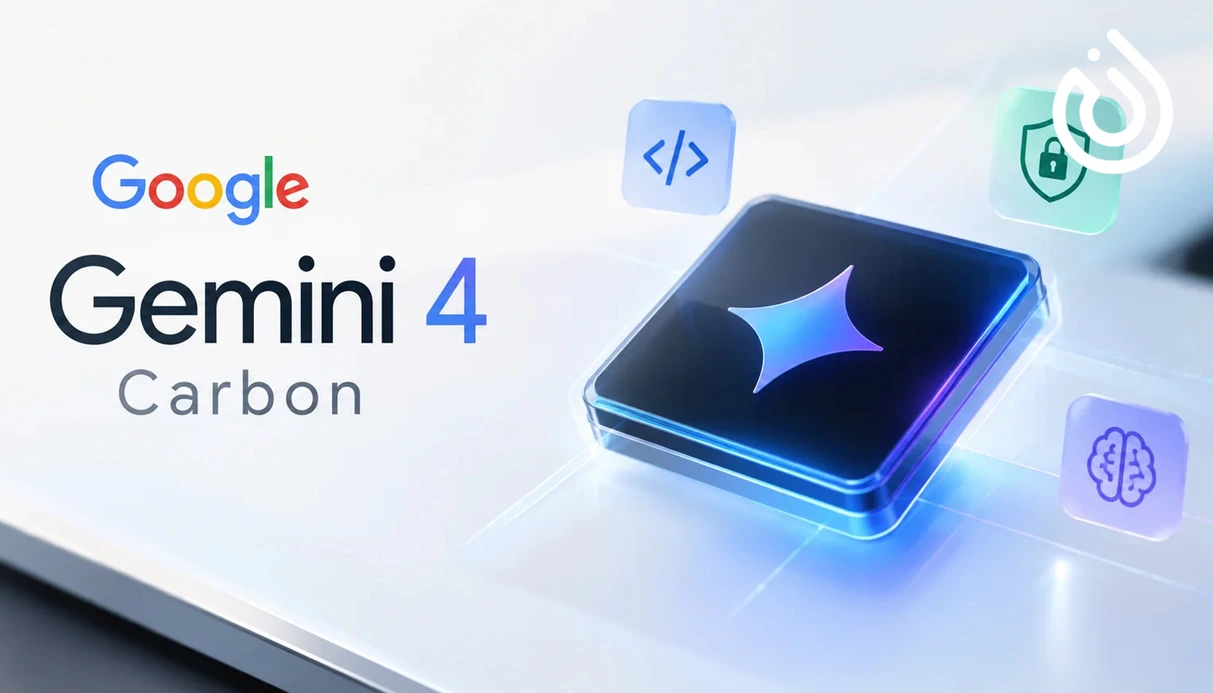
The artificial intelligence industry is evolving rapidly, with major technology companies constantly developing more advanced models to strengthen their positions in an increasingly competitive market. In this context, Google has introduced its new AI model, Gemini 4 Carbon, designed to focus on advanced programming, complex reasoning, cybersecurity, and multi-step task execution.
The announcement comes as Anthropic's Claude Opus 5.5 is also attracting considerable attention from technology professionals. Competition between these companies demonstrates that modern AI is no longer limited to generating text or answering simple questions. Instead, advanced models are increasingly expected to handle complex projects, analyze software code, and participate in specialized workflows.
But what is Gemini 4 Carbon? What makes it different from Claude Opus 5.5? And can it become one of the most powerful AI models available?
What Is Gemini 4 Carbon and What Are Its Main Features?
Gemini 4 Carbon is presented as Google's next-generation advanced AI model, developed to improve the ability of intelligent systems to perform specialized tasks. Unlike models primarily focused on content generation, general questions, and summarization, it is also designed to handle complex problems and long-running processes.
One of its key features is multi-step reasoning. This capability allows the model to examine different stages of a problem, evaluate relevant information, and compare possible solutions before producing an answer.
Its main application areas include:
Advanced programming: Analyzing software projects, identifying errors, and suggesting corrections.
Cybersecurity: Helping detect software vulnerabilities and evaluate security issues.
Complex reasoning: Solving multi-stage problems through structured analysis.
Long-running tasks: Managing workflows that require multiple processing stages.
Code analysis: Reviewing different parts of software projects and identifying potential structural problems.
According to the information provided about the model, Gemini 4 Carbon achieved a score of 59 in the Artificial Analysis Intelligence Index 5.0. This result may indicate strong performance in AI evaluations, although a proper assessment requires examining the methodology and comparing results with other models.
Gemini 4 Carbon vs. Claude Opus 5.5
One of the most important discussions following Google's announcement is the comparison between Gemini 4 Carbon and Anthropic's Claude Opus 5.5. Both models are designed to improve performance in specialized tasks, including programming, data analysis, and complex workflows.
However, differences in architecture, training methods, available tools, and optimization strategies may lead to different results depending on the application.
Programming and Software Development
Programming is one of the most competitive areas in modern AI development. Gemini 4 Carbon is designed to work with large software projects, helping developers examine code, identify complex bugs, and suggest potential solutions.
Claude Opus 5.5 is also positioned as a capable model for programming and agent-based workflows. Its ability to analyze multiple files, follow project stages, and assist with code improvements makes it an important competitor.
Ultimately, choosing between these models depends on the project, programming language, output quality, and required accuracy.
Cybersecurity and Vulnerability Detection
Cybersecurity is another major area of focus for Gemini 4 Carbon. As cyberattacks become more sophisticated, AI-powered tools are increasingly useful for analyzing software code and identifying security weaknesses.
According to the information provided about Gemini 4 Carbon, the model achieved:
88.2% in SEC-bench Pro.
54.8% in ExploitGym.
71% in CWE-bench.
These results suggest that the model may support specialized security tasks, including vulnerability analysis, risk assessment, and identifying software weaknesses.
However, AI should not be considered a complete replacement for cybersecurity professionals. Its findings should always be reviewed and validated by qualified experts.
Long-Running and Multi-Step Tasks
Another important feature of Gemini 4 Carbon is its focus on long-running tasks. Many real-world projects require more than a single question and answer.
For example, software development may involve requirements analysis, system design, coding, debugging, testing, and continuous improvements.
AI models capable of managing these workflows can become valuable assistants for software development teams and digital businesses.
Is Gemini 4 Carbon Better Than Claude Opus 5.5?
The answer depends on the application and evaluation criteria. Although Gemini 4 Carbon has reportedly achieved impressive results in certain specialized benchmarks, these scores alone do not prove that it is superior to Claude Opus 5.5 in every area.
A comprehensive comparison should consider:
Accuracy in complex tasks.
Code quality and debugging capabilities.
Processing speed.
API usage costs.
Reliability in long-running workflows.
Cybersecurity benchmark performance.
Integration with external tools and services.
Developers may prioritize code quality and debugging, while larger businesses may focus more on processing costs, data security, and operational reliability.
Therefore, testing both models with real-world tasks is the best way to determine which one suits a particular project.
How Much Does Gemini 4 Carbon Cost?
Pricing is an important factor when choosing an AI model, particularly for developers and businesses using APIs.
According to the information provided, the initial pricing for Gemini 4 Carbon is:
Input tokens: $2 per million tokens.
Output tokens: $10 per million tokens.
After the introductory period, these prices are expected to increase to:
Input tokens: $4 per million tokens.
Output tokens: $20 per million tokens.
The difference between input and output pricing is important because projects involving lengthy responses and multiple processing stages may generate higher output-token costs.
Initial access to the model is also described as limited, with cybersecurity professionals and selected specialists receiving early access.
Why Do AI Users Need a Stable Internet Connection?
As AI platforms become more advanced, reliable internet infrastructure is becoming increasingly important. Developers, server administrators, IT specialists, and online businesses often depend on stable connections to access digital services.
A static IP address can be useful in these situations. Unlike dynamic IP addresses, which may change over time, a static IP provides a consistent address for network connections.
Some common applications include:
Managing remote servers.
Accessing administrative dashboards.
Managing work accounts on platforms that support IP restrictions.
Reducing issues caused by frequent IP changes.
Managing remote network connections.
However, purchasing a static IP does not automatically guarantee access to Gemini, Claude, or other restricted services. Access depends on each platform's policies, account requirements, and geographical availability.
What Should You Consider Before Buying a Static IP?
Before choosing a static IP service, consider the following factors:
Dedicated or shared IP: Determine whether the address is exclusively assigned to you.
Geographical location: Choose a location that matches your requirements.
Connection stability: Check network reliability and service uptime.
Security: Review the provider's security measures.
Technical support: Make sure assistance is available when technical problems occur.
Service compatibility: Check whether the IP is suitable for your intended platforms.
Conclusion: The Future of AI with Gemini 4 Carbon
The introduction of Gemini 4 Carbon highlights the growing competition among major technology companies to develop AI models capable of doing more than answering simple questions. Advanced programming, multi-step reasoning, cybersecurity, and complex task management are among the capabilities that make this model worth examining.
Claude Opus 5.5 remains another important competitor, and choosing between the two models depends on individual requirements, project complexity, and practical evaluation results.
Alongside these developments, services such as ChatGPT continue to support content creation, programming, and everyday productivity. Users looking for additional communication and verification options may also consider buy a virtual number , depending on the registration requirements of the services they use.
Ultimately, combining advanced AI tools with reliable digital infrastructure can improve productivity, simplify online operations, and support business growth.